Harness Fitting on a Chihuahua Chest
Finding a harness that truly fits your Chihuahua can feel like trying to dress a tiny, wriggly fashion model – often leading to frustration with straps that gape, rub, or worse, allow for an easy escape. Many owners struggle to find that sweet spot between security and comfort for their delicate companions. This guide is here to walk you through everything you need to know about getting the perfect harness fit for your Chihuahua, ensuring their safety, health, and happiness on every adventure.
The Critical Importance of a Properly Fitted Harness for Chihuahuas
It's tempting to think that a harness is just another accessory, especially when your Chihuahua is so small. But for these tiny dogs, a well-fitted harness is a non-negotiable piece of safety equipment, far more than just a fashion statement. An ill-fitting harness can lead to a host of problems, from physical discomfort to dangerous situations, making the effort to get it right incredibly worthwhile.
Common Problems with Ill-Fitting Harnesses
Picture this: you're out for a stroll with your beloved Chihuahua, and suddenly they pull. If their harness isn't snug, those delicate straps can dig into their armpits, causing painful chafing, or worse, allow them to back out of it in a split second, darting into traffic or disappearing from sight. This isn't just a hypothetical scenario; it's a terrifying reality for many Chihuahua owners. A harness that’s too loose around the neck can let them slip free over their head. If it's too tight anywhere, especially across the chest or rib cage, it restricts movement, makes breathing uncomfortable, and can even contribute to chronic pain over time. We're talking about a dog with a very compact and unique body structure, so every millimeter of fit truly matters.
Another common issue is improper pressure distribution. If the harness isn't designed to distribute pressure across the chest rather than the neck, it can still mimic the dangers of a collar. A poorly designed or fitted harness might place undue stress on the fragile neck and throat area, completely defeating the purpose of choosing a harness over a collar in the first place. You might see your dog coughing, gagging, or even making a strange honking noise if there's pressure on their windpipe, which is especially concerning for a breed known for delicate tracheas.
How a Harness Protects a Chihuahua's Delicate Body
The primary reason most Chihuahua owners opt for a harness is to protect their dog's incredibly delicate neck and trachea. Unlike larger breeds with more robust necks, Chihuahuas have small, often fragile windpipes that are prone to Collapsing Trachea and the Chihuahua Honking Cough. Any sudden pull on a leash attached to a neck collar can cause significant damage, leading to irritation, inflammation, and even permanent collapse of the cartilage rings in the trachea. This is why a harness that properly distributes pressure across the chest and shoulders, away from the neck, is absolutely vital. Why a Harness Matters for a Chihuahua Windpipe delves deeper into this specific risk.
Beyond tracheal protection, a well-fitted harness also offers better support for their overall skeletal structure. Chihuahuas are small, yes, but they are also active and can be prone to various joint issues, such as Patellar Luxation, the Chihuahua's Commonest Joint Problem. A harness that allows for full, unrestricted movement of their shoulders and legs promotes healthy gait and reduces strain. When they wear a harness that's too restrictive or rubs, it can alter their natural movement, potentially exacerbating existing joint problems or leading to new ones. It also provides a secure point of contact for you, the handler, giving you better control without causing discomfort or injury to your tiny companion, which is invaluable when you're Walking a Chihuahua Twenty Minutes a Day in busy areas.
Understanding Chihuahua Body Shapes for Optimal Harness Fit
Chihuahuas, despite their small size, come in a surprising array of body shapes. You might have an "apple head" with a very compact body and a short neck, or a "deer head" with a slightly longer back and more slender build. These subtle differences mean that a "one-size-fits-all" approach to harnesses simply won't work. Understanding your specific Chihuahua's build is the first step to finding that perfect, comfortable fit.
Measuring Your Chihuahua Correctly
Accurate measurements are the foundation of a good harness fit. Don't just guess or rely on generic size charts that lump all "small" dogs together. Grab a soft tape measure – the kind tailors use, not a retractable metal one – and a pen and paper.
Here are the critical measurements you'll need:
- Neck Girth: Measure around the widest part of your Chihuahua's neck, where a collar would naturally rest, but remember that the harness itself won't be putting pressure here. This measurement helps ensure the neck opening of a vest-style or H-style harness isn't too large, preventing them from slipping out.
- Chest Girth (or Girth/Bust): This is the most crucial measurement. Measure around the deepest part of your Chihuahua's rib cage, just behind their front legs. This area should be the snuggest part of the harness to prevent escapes and ensure proper weight distribution.
- Back Length: While not always required for every harness style, knowing your Chihuahua's back length (from the base of the neck to the base of the tail) can be helpful, especially for vest-style harnesses or those with a longer back strap.
Pro Tip: Measure twice! It’s easy for a wiggling Chihuahua to throw off a measurement. Do it when they're relaxed, perhaps after a nap or a meal. You can even use a piece of string first, mark it, and then measure the string with a ruler if the tape measure itself is too cumbersome.
Here's a quick guide to help you measure:
| Measurement Point | Description | Purpose |
|---|---|---|
| Neck Girth | Around the thickest part of the neck, where it meets the shoulders. | Ensures the neck opening isn't too wide, preventing the harness from slipping over the head or restricting shoulder movement. |
| Chest Girth | Around the deepest part of the rib cage, just behind the front legs. | The most critical measurement for a secure, escape-proof fit that distributes pressure across the chest. This prevents the dog from backing out. |
| Back Length | From the base of the neck (between shoulder blades) to the base of the tail. | Useful for vest-style harnesses to ensure full coverage and for H-style harnesses to check the length of the spine strap, preventing chafing or interference with tail movement. |
Different Harness Styles and What Works Best for Chihuahuas
Once you have your measurements, you can start looking at harness styles. Not all harnesses are created equal for Chihuahuas, and some are definitively better at protecting their delicate physiology.
- Vest-Style Harnesses: These are often a fantastic choice for Chihuahuas. They cover a larger surface area of the chest, distributing pressure very widely and gently. This minimizes any single point of pressure, making them excellent for protecting the trachea and preventing chafing. They often have Velcro closures and a buckle, offering adjustability. Brands like Puppia (available on Amazon) are popular for their soft, breathable mesh designs that fit many Chihuahuas well. For a custom-like fit, you might want to consider options from BAXTER & Bella that focus on comfort and high-quality materials.
- H-Style Harnesses (Standard Strap Harness): These harnesses feature straps that form an "H" shape on the dog's back and chest. They are generally adjustable at the neck and chest, offering good flexibility. The key here is to ensure the straps are wide enough not to cut into the skin and that the chest strap sits low enough to avoid the trachea. Look for designs where the chest piece forms a solid band rather than just thin straps to maximize comfort. They can be a good option if properly adjusted and made for smaller dogs.
- Step-In Harnesses: These are popular for Chihuahuas because they are easy to put on – the dog just steps into two loops, and you bring the top up and buckle it. However, you need to be very careful with the fit around the legs and chest. If not sized correctly, they can rub in the armpits or allow for easy escapes if the chest strap is too loose. They typically offer less adjustability than H-style or vest harnesses, so accurate measurement is paramount.
- Front-Clip Harnesses: While excellent for discouraging pulling in larger dogs, front-clip harnesses can be a bit awkward on very small Chihuahuas. The leash attachment point is on the chest, which can sometimes interfere with their tiny gait or feel cumbersome. If you have a Chihuahua that pulls, focusing on Chihuahua Leash Training on a Harness with positive reinforcement is often a better long-term solution than relying on a front-clip design that might not be suitable for their unique size.
When choosing, prioritize soft, lightweight, and breathable materials. Heavy, stiff harnesses can overwhelm a Chihuahua's small frame and cause discomfort. Mesh, soft nylon, or fleece-lined options are usually best.
The Step-by-Step Guide to Fitting a Harness
You've measured, you've chosen a harness style that seems right, and now it's time for the moment of truth: putting it on your Chihuahua. This isn't a race; take your time, be patient, and make it a positive experience for your dog.
Checking for Snugness and Comfort
Once the harness is on your Chihuahua, the real fitting work begins. This is where you fine-tune the adjustments to ensure it's secure without being restrictive.
- The Two-Finger Rule: This is your golden rule. After adjusting all the straps, you should be able to comfortably slip two fingers flat (not stacked) between any part of the harness and your Chihuahua's body, especially under the straps around the chest and neck area (if applicable). If you can't fit two fingers, it's too tight. If you can fit more than two, it's too loose. This rule ensures enough room for breathing and movement without allowing for escapes.
- Check for Range of Motion: Watch your Chihuahua walk, trot, and even run a few steps in the harness. Do the straps restrict their shoulder movement? Are their legs moving freely? The harness should not rub against their armpits or interfere with their natural gait. For dogs prone to conditions like Chihuahua Arthritis in the Teenage Years or Chihuahua Legg-Calve-Perthes Disease, unrestricted movement is especially important.
- Observe Their Reaction: Your Chihuahua will tell you a lot through their body language. Are they hunching, trying to scratch it off, or moving stiffly? These are signs of discomfort. If they seem unfazed and move naturally, you're likely on the right track. Remember, some initial novelty is normal, but persistent signs of discomfort indicate a poor fit.
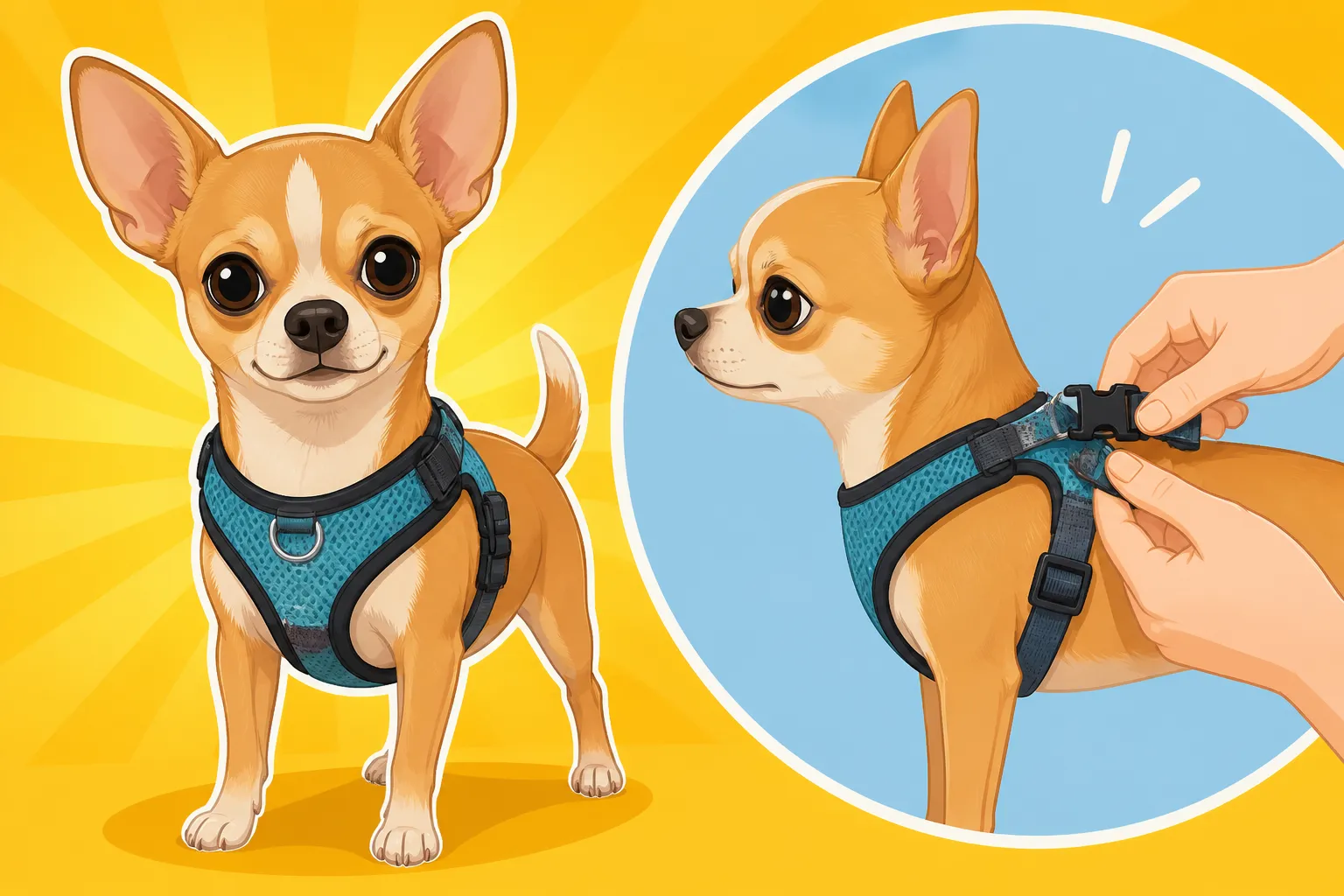
- Position of the Chest Strap: The most crucial element for Chihuahua safety is ensuring the chest strap sits low and wide across the chest bone (sternum), well below the delicate windpipe. It should never be riding up towards their throat. This is the design feature that truly differentiates a safe harness from a collar. If you find the strap creeping up, the harness style might be wrong for your Chihuahua's specific proportions, or it's simply adjusted too loosely.
Adjusting the Straps and Avoiding Common Mistakes
Most harnesses have multiple adjustment points – typically around the neck and chest. Take your time with each one.
- Start Loose, Then Tighten: Begin with the harness slightly loose, then gradually tighten each strap until you achieve the two-finger rule fit. Work symmetrically, tightening a little on one side, then the other, to keep the harness balanced.
- Secure the Buckles: Ensure all buckles are securely fastened. For Chihuahuas, many harnesses feature both Velcro and a buckle for double security, which is excellent for escape artists.
- Trim Excess Straps (Carefully): If there's a lot of excess strap flapping around, it can get caught, or your Chihuahua might chew on it. Once you're confident in the fit, you can carefully trim the excess nylon webbing, leaving an inch or two for future adjustments. If you do this, gently melt the cut edge with a lighter (briefly!) to prevent fraying, but be extremely cautious not to burn yourself or the harness.
- Avoid Over-Tightening: While you want it snug, resist the urge to over-tighten, especially around the rib cage. This can restrict breathing and cause pain. Chihuahuas are small, but they still need to expand their chests fully when they breathe, particularly after a burst of zoomies or when excited.
- Beware of "Gapping": If the neck opening or chest straps gape significantly when your Chihuahua stands still, they will likely be able to back out of it. This is a common issue with harnesses not specifically designed for the unique proportions of toy breeds.
- Double-Check After Walks: Always check the harness fit after a walk or a play session, especially with new harnesses. Straps can sometimes shift or loosen with movement.
Maintaining Harness Health and Identifying Wear
A perfectly fitted harness is an investment in your Chihuahua's safety and comfort. But like any piece of frequently used equipment, it needs care and regular inspection to ensure it remains in top condition. Neglecting its maintenance can lead to a harness that no longer fits well or, worse, breaks when you need it most.
When to Replace a Harness or Reassess Fit
Harnesses aren't designed to last forever, and a tiny Chihuahua can be surprisingly hard on their gear, even with their small stature. Knowing when to replace it is crucial.
- Signs of Wear and Tear: Regularly inspect your Chihuahua's harness for frayed straps, stretched elastic, bent or cracked buckles, or worn D-rings (where the leash attaches). Any of these can compromise the harness's security. Fraying can also become a source of irritation on your dog's skin, potentially leading to Chihuahua Skin Allergies and Hair Loss if it rubs constantly. If you spot significant damage, it's time for a replacement. Even a slightly sticky buckle can be a hazard in an emergency.
- Changes in Body Shape: Chihuahuas, like all dogs, can gain or lose weight. A small change of just half a pound on a six-pound Chihuahua is a significant percentage of their body mass. If your Chihuahua has put on a little weight, or conversely, lost some, their harness might no longer fit correctly. This is particularly true if you have a young Chihuahua who is still growing, or a senior Chihuahua whose weight might fluctuate. Always reassess the fit if there's been any noticeable change in their body condition, as even What One Extra Pound Does to a Chihuahua can alter how a harness sits.
- After Significant Cleaning: Some harness materials can shrink or stretch slightly after washing. If you've given the harness a deep clean, put it back on your Chihuahua and go through the two-finger check again to ensure it still fits perfectly.
- Age of the Harness: Even if it looks fine, materials can degrade over time due to sun exposure, repeated washing, and general use. A good rule of thumb is to consider replacing a heavily used harness every 1-2 years, or sooner if it shows signs of wear.
Remember, a loose strap on a walk could be the difference between a fun outing and a frantic search for an escaped pet. Always prioritize function over aesthetics when it comes to safety equipment for your Chihuahua.
Training Your Chihuahua to Love Their Harness
For some Chihuahuas, especially puppies or those new to harnesses, the process of putting it on can be a bit daunting. Their tiny size can make them feel overwhelmed, and some might even view it as a threat. Making harness time a positive experience from the start is key.
- Introduce It Gradually: Don't just clip it on and rush out the door. Let your Chihuahua sniff the harness, praise them, and give them a treat. Repeat this several times over a few days without even attempting to put it on.
- Short Sessions: Start by putting the harness on for very short periods indoors, immediately followed by praise and high-value treats. Let them wear it for just a minute or two, then take it off. Gradually increase the duration. This technique is part of Marker Training a Chihuahua From Eight Weeks.
- Positive Association: Always pair the harness with something positive. This could be a favorite toy, a delicious treat, or a short play session. Never use the harness as a punishment or in conjunction with anything negative.
- Practice Putting It On and Taking It Off: Many Chihuahuas are particular about being handled. Practice gently guiding their legs through step-in harnesses or slipping vest harnesses over their head. Make it a smooth, calm process. If your Chihuahua struggles with handling, particularly around their front legs or chest, it might be an indicator that they have discomfort or are sensitive to touch. Some online platforms like BAXTER & Bella offer training modules that include getting dogs comfortable with handling and gear, which can be invaluable.
- First Walks Are Key: Once they're comfortable wearing it inside, attach the leash and take them for a very short, positive walk outside, even if it's just to the end of the driveway. Keep it upbeat and rewarding. This helps reinforce that the harness means fun outings. For more tips on getting your Chihuahua comfortable outdoors, check out Building a Chihuahua's Confidence Outdoors.
By making harness fitting a calm, rewarding routine, you'll ensure that both you and your Chihuahua look forward to walks, knowing they are safe and comfortable.
Disclaimer
This article is for general informational purposes only and does not constitute professional advice. Laws, prices and regulations vary by location and change over time. Consult a qualified professional for guidance on your specific situation.