Weighing Chihuahua Food on a Kitchen Scale
One of the biggest struggles we face as Chihuahua parents is ensuring our tiny companions are getting just the right amount of food. It's incredibly easy to accidentally overfeed or underfeed a dog whose entire daily ration could fit in the palm of your hand, and these small discrepancies can lead to significant health issues. This guide is dedicated to showing you exactly why and how using a kitchen scale for your Chihuahua's food isn't just a good idea, but an essential tool for their long-term health and well-being.
Why Eyeballing Chihuahua Food Is a Recipe for Disaster
It’s tempting, isn't it? You scoop a little kibble into the bowl, maybe a bit more if they look particularly cute, or less if you think they’re getting a bit chunky. We've all been there. But when you’re dealing with a dog as small as a Chihuahua, this kind of casual approach to feeding can have surprisingly serious consequences. Their metabolism is unique, their caloric needs are minuscule compared to larger breeds, and their tiny bodies are extremely sensitive to imbalances.
The Tiny Margin for Error in Chihuahua Feeding
Imagine a Labrador. If you give a Labrador an extra tablespoon of food, it barely registers. It's a drop in the ocean of their daily caloric intake. Now, imagine giving your four-pound Chihuahua an extra tablespoon. That could be a significant percentage of their entire meal! For a dog that might only need around 200 calories a day, even an extra 10-20 calories here and there adds up incredibly fast. It’s like us adding an extra snack every day – over time, it compounds.
What looks like a tiny amount to our human eyes is a huge portion to their delicate digestive systems and small frames. This small margin for error means that traditional measuring cups, while seemingly precise for us, can be wildly inaccurate for a Chihuahua. The density of kibble, how much you pack it, and even the size of the kibble pieces can mean that one "quarter cup" might hold drastically more or less than another. This isn't just about weight gain; it's about making sure every meal provides consistent, balanced nutrition without overwhelming their system or leaving them hungry.
The Weight of Obesity on a Small Frame
We often associate obesity with large, sluggish dogs, but it's a very real and dangerous threat to Chihuahuas. Because they are so small, even an extra half-pound can place immense strain on their joints, heart, and respiratory system. An extra pound on a four-pound Chihuahua is a 25% increase in body weight – imagine if you gained 25% of your body weight! It’s a huge burden. This is why we talk so much about Chihuahua Obesity on a Six Pound Frame and the critical importance of keeping them at a healthy weight.
That seemingly innocent extra sprinkle of kibble can lead to a host of problems. Increased risk of Patellar Luxation, the Chihuahua's Commonest Joint Problem as more weight stresses those tiny kneecaps, worsening Collapsing Trachea and the Chihuahua Honking Cough due to fat deposits around the airway, and even exacerbating Chihuahua Heart Disease as the Breed Ages. Every single extra calorie matters. It's a tough truth, but those loving extra bits we give can unintentionally shorten their precious, long lives. Remember, What One Extra Pound Does to a Chihuahua is far more significant than on a larger dog.
The Inaccuracy of Measuring Cups: Why They Fail Tiny Dogs
Let’s be honest, we all have that set of measuring cups we use for baking or cooking. They seem standard, right? A quarter cup is a quarter cup. But when it comes to dog kibble, it’s a whole different ballgame. Kibble isn't a liquid, and it's not a uniform powder. It's made of irregular pieces, and how those pieces settle into a measuring cup can vary wildly. Some kibbles are dense, some are airy. Some are tiny, some are larger.
If you scoop quickly, you might get less. If you tap the cup to settle the kibble, you might get more. This means that a "quarter cup" of one brand's food could be 30 grams, while another brand's "quarter cup" might be 45 grams. That’s a massive difference for a Chihuahua! Why a Measuring Cup Is Useless for a Chihuahua boils down to the fact that volume measurements are simply not precise enough for the delicate caloric balance a toy breed requires. We need to move beyond guesswork and embrace a method that guarantees accuracy every single time.
How a Kitchen Scale Transforms Your Chihuahua's Diet
Bringing a kitchen scale into your dog feeding routine might seem like an extra step, but trust me, it quickly becomes second nature. And the benefits for your Chihuahua's health are truly invaluable. It removes all the guesswork and replaces it with reliable, precise information, helping you maintain optimal health for your little friend.
Precision Feeding for Optimal Health
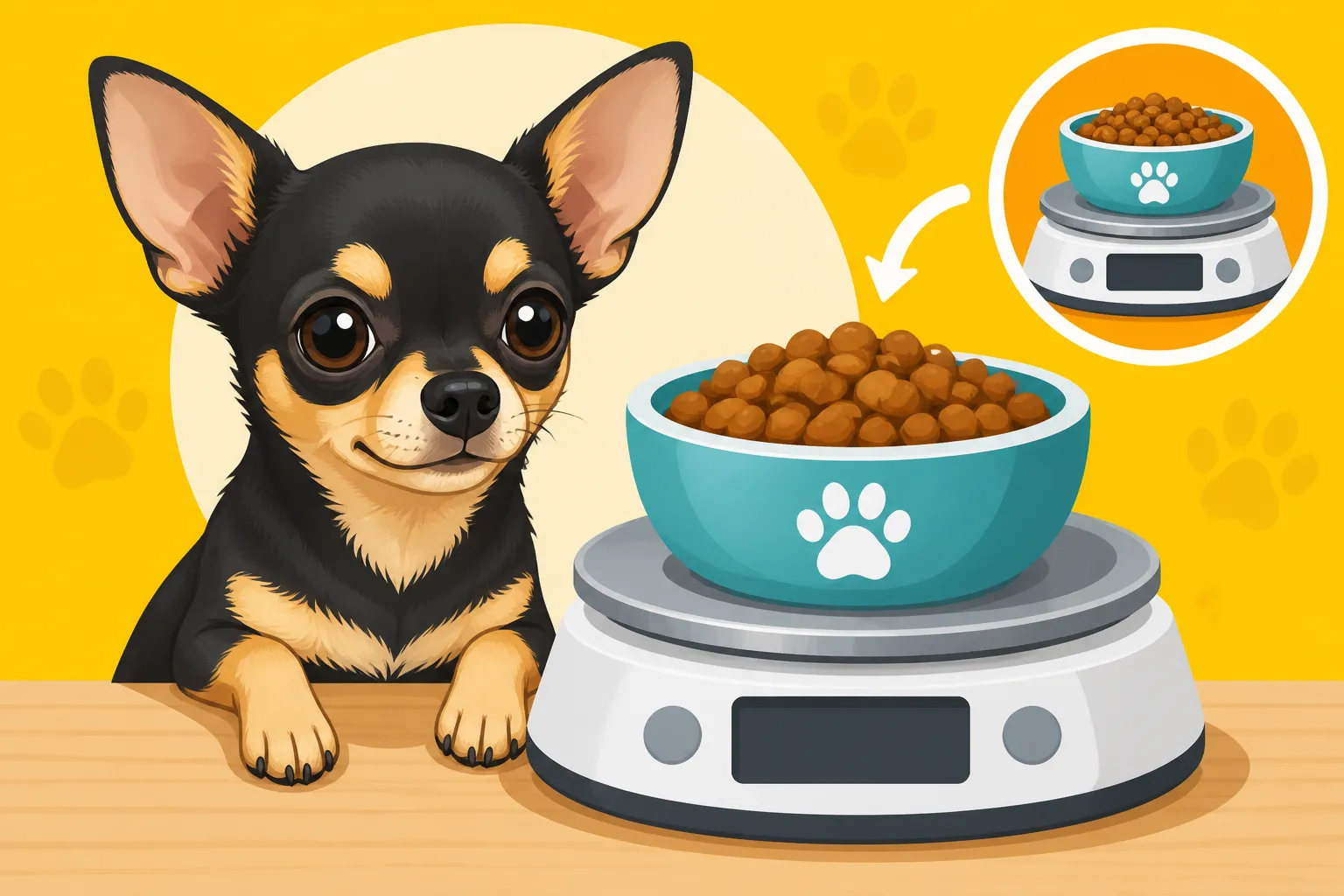
A kitchen scale allows you to feed your Chihuahua to the exact gram or ounce specified by your veterinarian or the food manufacturer. This level of precision is simply unmatched by any other method. Imagine a food bag that recommends "50 grams" for a dog of your Chihuahua's weight. With a scale, you pour the kibble directly into their bowl on the scale, and stop when it hits 50. No more wondering if your scoop was too full, too light, or if the kibble settled differently today.
This precision is crucial for managing their weight, preventing conditions like Chihuahua Hypoglycemia and the Puppy Emergency by ensuring consistent caloric intake, and supporting their overall energy levels. For Chihuahuas, whose metabolisms are often quite fast, getting the right amount of calories every day is paramount. It ensures they receive all the nutrients they need without consuming excess that can lead to obesity and associated health problems.
Understanding Grams and Ounces on Food Labels
Most quality dog food brands will provide feeding guidelines in both volumetric measurements (cups) and weight measurements (grams or ounces) on their packaging. It's always best to default to the weight measurement. If your scale has a "tare" function, you can place your Chihuahua's empty bowl on the scale, press "tare" to zero it out, and then add the food directly. This makes the process incredibly simple.
For example, if your vet recommends your Chihuahua eats 40 calories per pound of body weight, and your dog weighs 5 pounds, that's 200 calories a day. Your food bag will then tell you how many calories are in 100 grams of food. Let's say it's 350 calories per 100 grams. You can then do a simple calculation: (200 calories / 350 calories) * 100 grams = approximately 57 grams of food per day. This might sound complicated, but once you do the math, you'll have your target weight for each meal. Calculating a Chihuahua Ration at Forty Calories a Pound becomes straightforward with a scale.
Consistency, Not Guesswork, in Every Meal
The beauty of using a kitchen scale is the sheer consistency it provides. Every single meal, your Chihuahua gets the exact same amount of food, day in and day out. This is incredibly important for their digestion and overall health. Fluctuations in portion size can lead to digestive upset, energy crashes, or unwanted weight gain.
This table highlights the stark difference between relying on estimates and using a scale:
| Feature | Eyeballing / Measuring Cup Method | Kitchen Scale Method |
|---|---|---|
| Accuracy | Low (highly variable based on kibble, scoop, user) | High (precise to the gram or fraction of an ounce) |
| Consistency | Poor (portions change daily) | Excellent (same portion every time) |
| Health Impact | Risk of under/overfeeding, weight issues, nutrient imbalance | Optimal weight management, stable energy, balanced nutrition |
| Effort | Seems low, but requires constant subjective judgment | Initial setup, then quick and objective daily use |
| Information | Minimal (no true understanding of caloric intake) | Direct link to caloric intake and food guidelines |
By making this small change, you’re taking a huge step towards ensuring your Chihuahua lives their healthiest, happiest life. It's a simple, actionable step that directly impacts their longevity and quality of life. For more on exact measurements, see Measuring Chihuahua Food to the Gram.
Choosing the Right Kitchen Scale for Your Chihuahua's Needs
Picking out a kitchen scale might seem like a small decision, but a good one can make your daily feeding routine so much easier and more reliable. You don't need anything fancy or expensive, just something accurate and user-friendly.
Key Features to Look For in a Pet Food Scale
When you're shopping for a kitchen scale for your Chihuahua, keep these essential features in mind:
- Accuracy: This is non-negotiable. Look for scales that measure in increments of 1 gram or 0.1 ounces. Many standard kitchen scales are precise enough.
- Tare Function: This is a lifesaver! The tare function allows you to zero out the weight of the bowl before you add the food. So you put the empty bowl on, press "tare," and then only the weight of the kibble is displayed. This saves you from having to do mental math or subtract bowl weight.
- Easy to Clean: Spills happen, especially with tiny kibble. A scale with a smooth, wipeable surface, preferably stainless steel or tempered glass, will make cleanup a breeze. Avoid scales with lots of nooks and crannies where food particles can get stuck.
- Compact Size: You'll likely be keeping this scale on your counter or in a nearby cabinet. A smaller, lightweight scale is usually perfect, as Chihuahua portions are so tiny. You won't need a huge platform for their little bowls. You can find excellent options on retailers like Amazon or Chewy, specifically looking for "digital kitchen scale" or "food scale."
- Units of Measurement: Ensure it can switch between grams and ounces. Most dog food labels provide recommendations in grams, but some might use ounces, so having both options is helpful.
Don't overthink it. A basic digital kitchen scale, often available for a reasonable price, will likely meet all these requirements perfectly.
Digital vs. Analog: Making the Smart Choice
When it comes to scales, you'll generally find two types:
- Analog Scales: These are the ones with a dial and a spring mechanism. While charmingly retro, they are generally not recommended for measuring Chihuahua food. Their accuracy is typically much lower, and it's hard to read precise measurements for such small quantities. That tiny wiggle of a needle might be the difference of several grams, which, as we've discussed, is a lot for a Chihuahua.
- Digital Scales: These are the clear winners. They provide a precise numerical readout on a screen, usually to the nearest gram or tenth of an ounce. They are much easier to read, almost always include a tare function, and are generally more consistent. This is exactly what you need for accurate feeding.
Integrating the Scale into Your Daily Routine
Making the switch to scale feeding is surprisingly simple. Here's how to ease into it:
- Placement: Keep your scale in a convenient spot, perhaps right next to your dog food storage container.
- Prep Your Bowl: Place your Chihuahua's clean food bowl on the scale.
- Tare It: Hit the "tare" button to zero out the weight of the bowl.
- Add Food: Slowly pour or scoop your Chihuahua's kibble into the bowl until the digital display shows your target weight (e.g., 28 grams for breakfast, 29 grams for dinner if their total is 57 grams a day).
- Serve! It's that easy.
At first, you might feel a little awkward, but within a few days, it will become an automatic part of your routine. You'll gain peace of mind knowing you're feeding them precisely. For those using fresh food services like Ollie, the portions are often already pre-measured and sealed, taking the guesswork out entirely, but for traditional kibble, a scale is a must.
Beyond the Scale: Other Feeding Best Practices for Chihuahuas
While weighing food is a game-changer, it’s part of a larger picture of excellent nutritional care for your Chihuahua. There are other aspects of their diet and eating habits that are just as vital to their health and happiness.
The Importance of Calorie Counts, Not Just Volume
Using a scale gives you the how much, but it’s crucial to understand the what behind that number. Every dog food has a different caloric density, meaning a gram of one brand's kibble might have more calories than a gram of another. This is why looking at the "kcal/kg" or "calories per cup" (and then converting to weight) on your dog food bag is so important.
Your vet can help you determine the ideal daily caloric intake for your individual Chihuahua, taking into account their age, activity level, and whether they need to lose, gain, or maintain weight. This number, often expressed as Daily Calories for a Three to Seven Pound Chihuahua, is your North Star. Once you know their target calories, you can then use the food’s calorie density (e.g., "350 kcal per 100 grams") to calculate the precise weight of food they need each day. This complete picture ensures you’re not just feeding a number, but truly fueling their body appropriately.
Smart Meal Timing and Frequency for Tiny Tummies
Because Chihuahuas are prone to Chihuahua Hypoglycemia in the First Twelve Weeks, especially as puppies, and have such fast metabolisms, when and how often you feed them is just as important as how much. Rather than one large meal, which can overwhelm their small digestive systems and lead to blood sugar dips, multiple smaller meals throughout the day are often recommended.
For adult Chihuahuas, Three Small Meals a Day for a Chihuahua is a fantastic approach. This helps maintain stable blood sugar levels, keeps their energy consistent, and prevents them from getting overly hungry. A common schedule might be breakfast, a mid-afternoon meal, and a small meal right before bed. This last meal is especially important to carry them through the long hours overnight and prevent low blood sugar episodes. Understanding Chihuahua Meal Timing Against Low Blood Sugar is vital for their well-being. Avoid leaving food out all day, as this can lead to overeating and makes it impossible to accurately track intake or prevent issues like resource guarding. Why a Chihuahua Should Never Graze All Day can also contribute to dental problems and obesity.
Monitoring Body Condition: The Visual Check-in
Even with precise weighing, regularly assessing your Chihuahua's body condition is crucial. Scales give you the numbers, but your hands give you the feel. You should be able to feel your Chihuahua’s ribs easily, without them being visibly prominent. They should have a defined waist when viewed from above, and their belly should tuck up slightly when viewed from the side.
If you start feeling too much padding over their ribs, or if their waistline begins to disappear, it's a sign that even with precise measurements, their caloric intake might be too high for their current activity level or metabolism. Conversely, if their ribs feel too sharp and prominent, they might need a slight increase in food. Learning to Feel a Chihuahua's Ribs and Waist is an important skill. Always consult your vet if you're unsure about their body condition or need to make significant dietary adjustments. They can provide personalized advice and ensure your Chihuahua is thriving at their ideal weight.
Disclaimer
This article is for general informational purposes only and does not constitute professional advice. Laws, prices and regulations vary by location and change over time. Consult a qualified professional for guidance on your specific situation.