Whether Smooth and Long Coats Interbreed
One of the questions I hear most often from new Chihuahua owners, or even those just admiring the breed, is about their two distinct coat types. You see the sleek, short-haired dogs, and then you see the glorious, flowing long-haired ones, and it's natural to wonder if they're almost like different breeds. People often assume that you couldn't possibly breed a smooth coat Chihuahua with a long coat Chihuahua and produce healthy, purebred puppies, but the truth might surprise you. This guide will explore the fascinating genetics behind these beautiful differences and explain exactly what happens when smooth and long coat Chihuahuas are bred together.
The Chihuahua's Two Official Coat Varieties
Before we dive into the genetics of breeding, let's take a moment to appreciate the two distinct coat varieties that make the Chihuahua breed so diverse and charming. While they look quite different, remember that both are 100% purebred Chihuahuas, sharing the same spirited personality and toy-sized stature. It's often misunderstood, but these are simply variations within the same breed standard.
Understanding the Smooth Coat
The smooth coat Chihuahua, often referred to as a short-haired Chihuahua, is perhaps the more widely recognized of the two. Their fur is short, soft, and lies close to the body, giving them a sleek and refined appearance. You might notice a slightly thicker ruff around the neck and some feathering on the tail, but overall, it's a very low-maintenance coat. Many people are drawn to the smooth coat for its apparent ease of grooming; a quick brush a few times a week is usually all it takes to keep them looking sharp. They dry quickly after a bath and generally don't pick up as much outdoor debris. However, this coat offers less insulation, which is why you'll often see smooth coats shivering even indoors and needing sweaters or coats in cooler weather. The Smooth Coat Chihuahua Variety has a certain elegance that many adore.
Appreciating the Long Coat
Then we have the long coat Chihuahua, a vision of flowing elegance. These Chihuahuas boast soft, fine fur that can be either flat or slightly wavy, with a distinctive ruff around the neck and beautiful feathering on the ears, legs, and tail. Their coat grows in gradually, so a long coat puppy might not show its full splendor until it's well into its first year or even later. While they require a bit more grooming than their smooth-coated counterparts—daily brushing is a good idea to prevent mats and tangles, especially behind the ears and under the legs—the effort is well worth it for their stunning appearance. Many owners find the long coat's luxuriant texture incredibly appealing. The Long Coat Chihuahua Variety often carries a regal air.
The Genetics Behind Chihuahua Coat Length
The question of whether smooth and long coats can interbreed isn't just about what looks good; it's a fundamental question about canine genetics. The answer is a resounding "yes," and it's because the two coat types are determined by a simple recessive gene.
How Coat Genes Work in Chihuahuas
The length of a Chihuahua's coat is primarily controlled by a single gene, with two possible alleles (variants): one for short hair and one for long hair. The allele for short hair is dominant, and the allele for long hair is recessive. What this means in practice is that if a Chihuahua inherits even one copy of the short-hair gene, it will have a smooth coat. A long coat Chihuahua, on the other hand, must inherit two copies of the long-hair gene, one from each parent.
Think of it like this:
- SS: Two copies of the short-hair gene. The dog will have a smooth coat.
- SL: One copy of the short-hair gene, one copy of the long-hair gene. The dog will have a smooth coat (because short is dominant), but it "carries" the long-hair gene.
- LL: Two copies of the long-hair gene. The dog will have a long coat.
This genetic principle is why you can breed a smooth coat and a long coat together, and it's completely within the norms of responsible Chihuahua breeding. It's not like crossing two different breeds; it's simply breeding two variations of the same breed. Breeders often keep detailed records and sometimes even use genetic testing to understand which genes their dogs carry, helping them predict litter outcomes. You can learn more about The Chihuahua From Techichi to American Lapdog and how these traits developed over time.
Breeding Smooth and Long Coats Together
So, when a smooth coat Chihuahua and a long coat Chihuahua are bred, what happens? It largely depends on the specific genetic makeup of the smooth coat parent.
- Smooth Coat (SS) x Long Coat (LL): All puppies in this litter will be smooth coats (SL), but every single one will carry the gene for long hair. This means if any of these puppies are later bred with another dog carrying the long-hair gene, they could produce long-coat puppies.
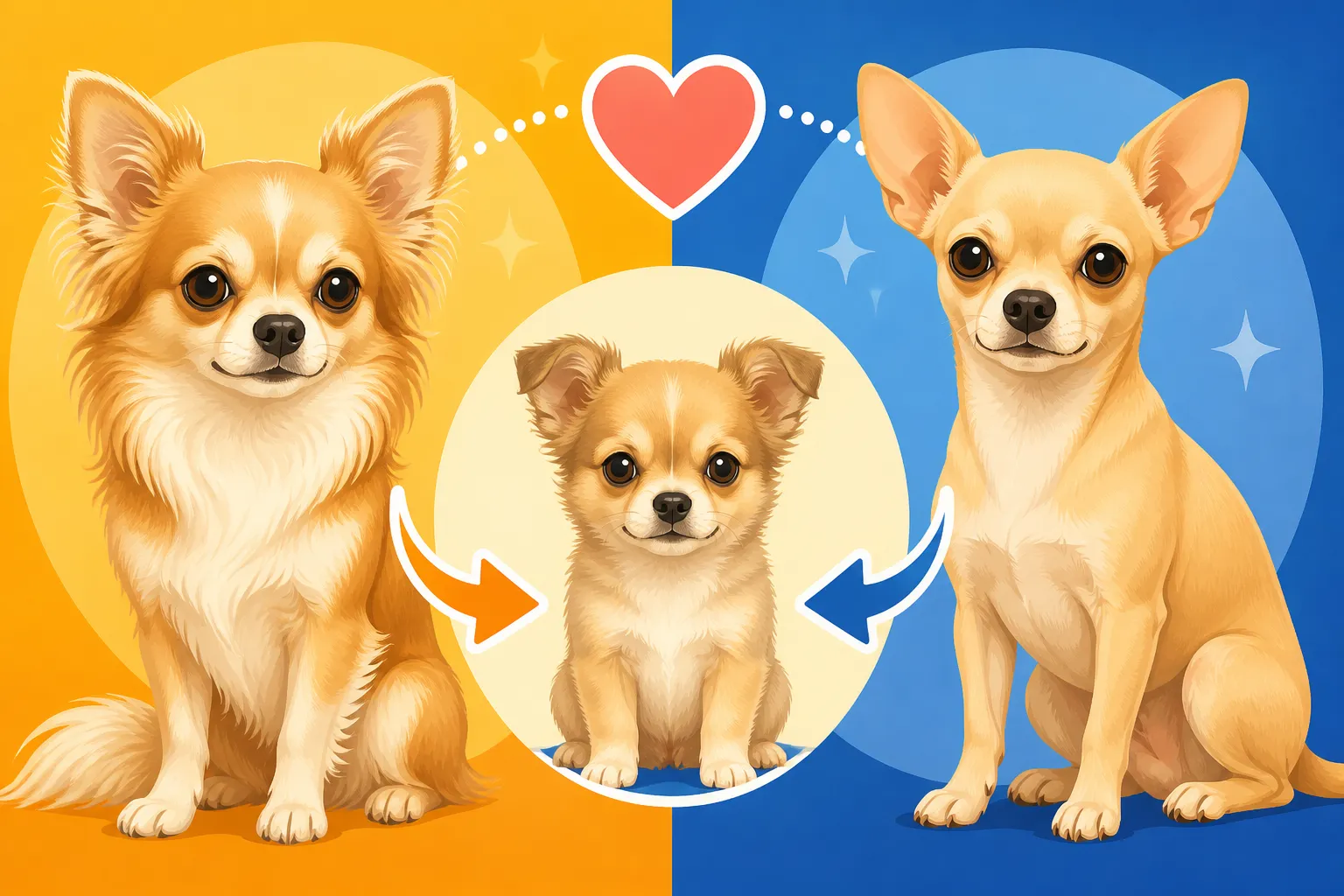
- Smooth Coat (SL) x Long Coat (LL): In this scenario, approximately 50% of the puppies will be smooth coats carrying the long-hair gene (SL), and 50% will be long coats (LL). This type of pairing can yield a mixed litter of both coat types.
- Smooth Coat (SL) x Smooth Coat (SL): This is an interesting one! While both parents are smooth coats, if they both carry the long-hair gene, you could see approximately 25% long coat puppies (LL), 50% smooth coat puppies carrying long-hair (SL), and 25% smooth coat puppies not carrying long-hair (SS). This is often how a long coat puppy can pop up unexpectedly in a litter from two smooth-coated parents.
Responsible breeders understand these genetics intimately. They're not just crossing random dogs; they're making informed decisions based on pedigree and genetic knowledge. This careful selection ensures the health and consistency of the breed, regardless of coat length. It's why asking Questions Worth Asking a Chihuahua Breeder about their breeding practices, including coat genetics, is so important.
What to Expect from a Mixed-Coat Litter
For someone new to Chihuahuas, the idea of a litter containing both smooth and long coats might seem a bit like magic, but it’s a perfectly normal and common occurrence. Understanding what to expect can ease any surprise and help you appreciate the beautiful diversity within the breed.
The Surprise of a Mixed Litter
Imagine bringing home a litter of tiny Chihuahua puppies, some with sleek, short coats and others with soft, fluffy fur already hinting at their future flowing locks. This "surprise" of a mixed litter is a delightful reality for many breeders who pair a smooth coat carrying the long-hair gene with a long coat. It highlights the underlying genetic tapestry of the breed. Each puppy, regardless of coat, will share the same vibrant personality and endearing Chihuahua traits. They might play differently—the smooth coat perhaps darting with slightly less impediment, the long coat perhaps enjoying a bit more insulation on chilly mornings—but they are all Chihuahuas through and through. You might find different grooming tools necessary, like a soft slicker brush for the long coats available on sites like Chewy, or simply a rubber curry comb for the smooth coats.
Predicting Coat Types in Puppies
While genetics offers clear percentages, predicting the exact number of smooth versus long coats in any given litter is never an exact science. You might get a litter of six puppies from an SL x LL pairing, and instead of a perfect 3/3 split, you could end up with five smooths and one long, or vice versa. It’s the beauty of genetic recombination! For breeders, this means preparing for either outcome, both in terms of potential buyer interest and the specific care needs for each coat type. For prospective owners, it means being open to either a smooth or a long coat, or perhaps patiently waiting for a litter with the desired coat length. Good breeders can discuss their historical litter outcomes and what they anticipate, providing valuable insight into what The Health Tests a Chihuahua Breeder Should Run and what genetic traits they are working with.
| Feature | Smooth Coat Chihuahua | Long Coat Chihuahua | Interbreeding Outcome (SL x LL) |
|---|---|---|---|
| Coat Length | Short, sleek, lies close to body | Long, soft, can be flat or wavy, with feathering | ~50% Smooth (carriers), ~50% Long |
| Genetic Trait | Dominant (requires at least one 'S' allele) | Recessive (requires two 'L' alleles) | Parents carry 'S' and 'L' alleles |
| Grooming Needs | Low; minimal brushing, quick drying | Moderate; daily brushing to prevent mats, slower drying | Varies by puppy's coat type |
| Insulation | Less; often requires sweaters in cool weather | More; provides better natural warmth | Varies by puppy's coat type |
| Appearance | Sleek, refined, sometimes a thicker neck ruff | Elegant, flowing, feathery ears, legs, and tail | Both distinct appearances possible |
| Interbreeds? | Yes, with long coats (if carrying 'L' allele) | Yes, with smooth coats (if provides 'L' allele) | Yes, common and genetically sound practice |
Why Breeders Mix Coat Varieties
You might wonder why breeders would deliberately mix coat varieties if it means producing both types in a single litter. There are several very good reasons why experienced and responsible Chihuahua breeders choose to do this, all centered around maintaining the health and integrity of the breed as a whole.
Expanding the Gene Pool
One of the primary reasons to interbreed smooth and long coats is to maintain a healthy and diverse gene pool. Limiting breeding to only smooth-to-smooth or long-to-long pairings can inadvertently narrow the genetic diversity over generations. A smaller gene pool can increase the risk of inherited health issues becoming more prevalent. By breeding across coat types, breeders can introduce new genetic lines, reinforcing the overall health and vigor of the Chihuahua breed. This helps prevent the concentration of undesirable traits or diseases that might be inadvertently linked to one coat line. This approach ensures that future generations of Chihuahuas remain robust, a key aspect of Why Chihuahuas Outlive Almost Every Other Breed.
Focusing on Other Breed Traits
For a dedicated Chihuahua breeder, coat length is just one characteristic among many. They are equally, if not more, concerned with temperament, conformation (how well a dog adheres to the breed standard's physical description), health clearances, and overall vitality. If a smooth coat Chihuahua has an exceptional temperament, strong health history, and excellent conformation, a breeder might choose to pair it with a long coat that also excels in these areas, even if it means a mixed-coat litter. The goal is to produce the best possible Chihuahua puppies, not just a specific coat type. So, if a long-coat male has particularly desirable traits like a perfect bite or an ideal ear set, breeding him to a smooth-coat female who is a carrier might be the best way to pass on those valuable traits, ensuring the continuation of the breed's quality across all aspects, not just hair. This holistic approach is why you’ll often find high-quality products, from specific diets to comfortable beds, on platforms like Chewy, catering to all the diverse needs of Chihuahuas, regardless of their coat.
Mixing coat varieties is a testament to the fact that responsible breeders see beyond superficial traits, focusing instead on the holistic health and future of the breed. They are stewards of the Chihuahua, working to ensure that the dogs remain healthy, happy, and true to their unique character, whether they boast a sleek smooth coat or a luxurious long one. Both The Two Chihuahua Coat Varieties Explained are valued for their individual beauty and charm, and both contribute equally to the rich tapestry of the breed.
Disclaimer
This article is for general informational purposes only and does not constitute professional advice. Laws, prices and regulations vary by location and change over time. Consult a qualified professional for guidance on your specific situation.