How Early Chihuahuas Looked in Old Photographs
It can be incredibly hard to imagine what a breed looked like decades, or even a century, ago. We're so used to seeing Chihuahuas with their distinctive apple heads and dainty frames today that it's easy to assume they've always looked exactly this way. But like all breeds, Chihuahuas have evolved, and old photographs offer us a fascinating, tangible window into their past, revealing a subtly different picture than the one we hold in our minds today. This guide will take you on a journey through those vintage snapshots, showing you what early Chihuahuas truly looked like and how those images shaped the breed we adore.
Stepping Back in Time: The Dawn of the Modern Chihuahua Era
Before the age of widespread breed standards and global travel, dogs were often regional variations, sometimes quite diverse even within the same general "type." For Chihuahuas, their distinct journey into the American consciousness, and subsequently into the photographic record, began in earnest in the mid-19th century. Understanding this context helps us appreciate the rare and precious nature of those early images.
The First Glimpses: Chihuahuas Arrive in America
Imagine a time when the only dogs you knew were the ones local to your area, or perhaps a few European breeds imported by settlers. Then, in the mid-1800s, tales began to emerge from Mexico of tiny, captivating dogs. These were the ancestors of our modern Chihuahuas, often found in the state of Chihuahua, from which they eventually got their name. American travelers, particularly those exploring the Southwest after the Mexican-American War, started bringing these curious little canines back across the border. This marked the true beginning of the Chihuahua's presence in the United States. How Americans Found Chihuahuas in the 1800s explains this fascinating period in more detail.
At this stage, there wasn't a rigid "breed standard" as we understand it today. These were simply small, appealing dogs, often bought from vendors or found in villages. Each one might have looked a little different from the next, a charming mosaic of what the breed would eventually become. Photographs from this era are invaluable because they provide concrete evidence, stopping time to show us exactly what these imported dogs looked like before official kennel clubs and breed shows began to homogenize their appearance. They were novelties, conversation starters, and beloved companions, and the camera was there to capture their unique charm.
When Photography Met the Chihuahua: Early Depictions
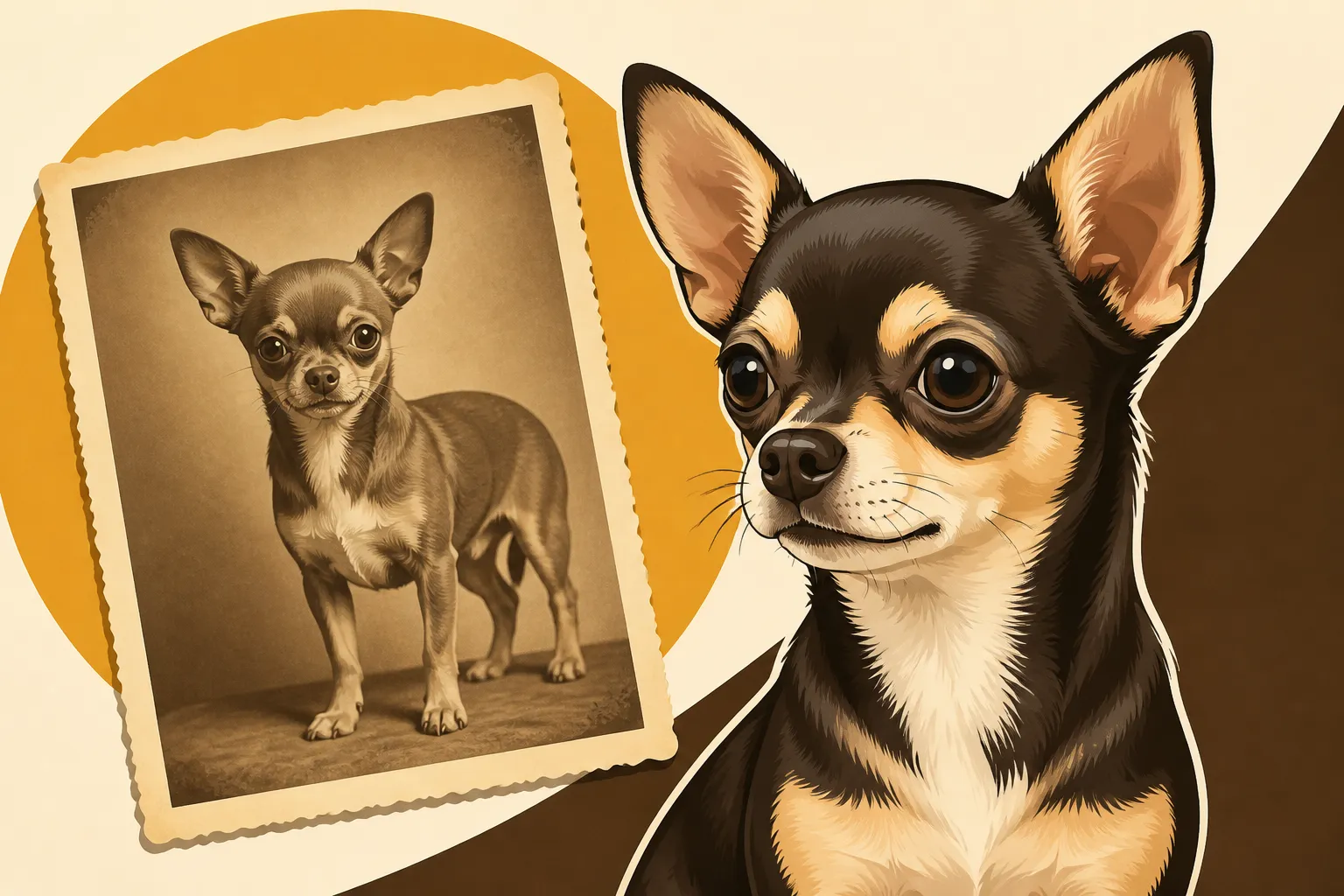
The late 19th and early 20th centuries saw the rise of photography as a more accessible art form, moving from cumbersome studio setups to somewhat more portable equipment. This coincided perfectly with the Chihuahua's growing popularity. Early photographs of Chihuahuas often depict them in formal studio settings, posed meticulously on velvet cushions or next to their elegantly dressed owners. These weren't candid snapshots of dogs mid-zoomie; they were carefully composed portraits meant to capture the essence of this exotic new pet.
The limitations of early photographic technology—long exposure times, black and white film—meant that action shots were rare. Instead, we see Chihuahuas sitting still, often with a curious or alert expression, sometimes looking a little bewildered by the process. These images give us clues not just about their physical traits, but also about the way they were valued and presented. They were cherished possessions, often held by women, symbolizing a certain grace and delicate companionship. These photos are a stark contrast to the dynamic, high-definition images we capture of our Chihuahuas today, wrestling with toys or sprinting across a dog park. They remind us that the way we interact with and document our pets has shifted dramatically, but the fundamental love for these tiny dogs remains.
Unpacking the Features: What Early Photographs Reveal
When you pore over these vintage photographs, a distinct image of the early Chihuahua begins to emerge. While recognizable, there are subtle differences from the modern ideal that are quite striking. It's like looking at an old family photo and seeing a distant relative who shares your genes but has a slightly different nose or eye shape.
The Evolving Head Shape: From "Terrier-Like" to "Apple-Domed"
One of the most noticeable differences in early Chihuahua photographs lies in their head shape. Many of the dogs captured in these turn-of-the-century images often display a less pronounced "apple head" than what is preferred today. Instead, you might see a more moderately domed skull, sometimes even a flatter top, reminiscent of a terrier or what we might call a "deer head" Chihuahua now. Their muzzles, while still short, could appear slightly longer and less abruptly "broken" than the ultra-short muzzles we often see in show-quality Chihuahuas today.
The large, expressive eyes are a constant, but their set might appear a little less prominent, nestled a bit further into the skull. The ears, always erect and large for their size, seem to maintain their characteristic "bat-ear" appeal. It's fascinating to trace how breeders, guided by emerging standards and aesthetic preferences, gradually shifted towards the more exaggerated, rounded "apple head" over decades. The emphasis on the pronounced dome and short, pointed muzzle became a hallmark, distinguishing them further from other small breeds. If you're curious about the different head types, you might want to read Apple Head Against Deer Head Chihuahuas.
Body and Bone: A Sturdier Build?
While always small, early Chihuahuas in photographs often appear to possess a slightly more substantial, almost rustic build compared to some of the extremely delicate Chihuahuas bred for tiny size today. They weren't "teacups" in the modern, often unhealthy sense of the term. Instead, they seemed well-muscled for their small stature, with good bone density. Their bodies might have been a tad longer in proportion to their height, giving them a less "square" appearance than some modern show lines.
You rarely see images of dogs that look fragile or overly refined. They look like robust little survivors, capable of traversing varied terrains, even if those terrains were just the dirt roads of their native Mexico. This sturdiness is a testament to their origins as working companions rather than purely ornamental lapdogs. It speaks to a time before the intense focus on shrinking the breed to extreme sizes, a practice that has unfortunately led to health challenges in some lines today. The official breed standard, eventually recognized by the AKC in 1904, still sets a The Six Pound Limit in the Chihuahua Standard, reflecting a healthy, balanced toy dog, not a micro-sized novelty.
Coat Varieties and Colors: Less Uniform Than Today?
Early photographs, particularly those in black and white or sepia tones, make it challenging to discern specific colors with absolute certainty. However, they do provide clues about coat types and patterns. You can clearly see both smooth-coated and long-coated Chihuahuas present in these early images, indicating that both varieties have existed from the breed's formative years. The long-coated dogs often show elegant feathering on their ears, legs, and tail, similar to what we appreciate today. The Smooth Coat Chihuahua Variety and The Long Coat Chihuahua Variety delve into these differences.
What might be less uniform is the perceived "quality" of the coat in terms of density or length, as breeding programs hadn't yet been fine-tuned for specific show-ring aesthetics. There's a natural, almost unmanicured look to some of these coats, suggesting less emphasis on elaborate grooming or specific coat textures. In terms of color, while black and tan, fawn, and white appear common (deduced from shading), it's harder to say if some of the more "designer" colors like blue or merle were as prevalent or even sought after. The focus was more on the dog itself rather than specific, rare colorations. Many of the basic, classic Chihuahua colors have been around since the beginning, and seeing them in these old photos provides a sense of continuity.
The Chihuahua's Demeanor: Beyond Physical Traits
While photographs primarily capture physical appearance, they also offer subtle hints about a dog's personality and the way they were perceived and handled by humans. These historical snapshots allow us to imagine the essence of the early Chihuahua beyond just their looks.
Expression and Temperament Captured in Time
Despite the static nature of early portrait photography, the expressions on the faces of these Chihuahuas are incredibly telling. Many exhibit that classic Chihuahua alertness—bright, intelligent eyes, and ears perked, often conveying a keen interest in their surroundings, even if those surroundings were just a photographer's studio. You can see hints of the "terrier-like" spirit that the breed standard would later emphasize: a confident, sometimes slightly sassy, demeanor packed into a tiny frame. Chihuahua Temperament and What the Standard Asks For describes this in detail.
They don't often look timid or overly shy; rather, they project a sense of self-possession. Some images show a charming seriousness, while others hint at playful mischief. This suggests that the bold, "big dog in a small body" personality of the Chihuahua isn't a modern development but an intrinsic part of their heritage. Their expressions in these old photos speak volumes about their character, reinforcing that they've always been dogs with strong personalities, not just pretty faces. You can almost hear a little huff or a tiny bark captured in their gaze.
Early Handling and Presentation: A Different Relationship?
The way Chihuahuas are handled and presented in early photographs also provides insights into the human-animal bond of the era. Many images show Chihuahuas cradled gently in arms, often by women, emphasizing their role as cherished lap companions. They are rarely depicted struggling or appearing uncomfortable with human contact, suggesting that early Chihuahuas, like their modern counterparts, generally thrived on affection and closeness.
You'll see them posed on ornate furniture, on a lady's lap, or even peeking out from a small bag—a practice that, for better or worse, has continued to this day. This presentation speaks to their status as luxury items and beloved pets, distinguishing them from larger, more utilitarian working dogs. While today we often focus on active outings and rigorous training, these photos highlight a different facet of companionship: quiet, devoted presence. It's a sweet reminder that for all the advancements in dog care and understanding, the fundamental joy of having a tiny, warm body snuggled beside you has remained unchanged for generations.
The Legacy of the Lens: How Early Photos Shaped the Breed
These old photographs aren't just quaint relics; they are pivotal documents that played a significant role in shaping the Chihuahua breed as we know it today. They provided visual benchmarks and influenced breeders' choices, charting a course for the breed's future.
Influencing the Breed Standard: A Visual Guide
As the popularity of Chihuahuas grew in America, so did the desire for formal recognition and a consistent ideal for the breed. The American Kennel Club (AKC) officially recognized the Chihuahua in 1904, and with that came the establishment of a written breed standard. But how do you write a standard without clear examples? Early photographs served as crucial visual references. They captured the "look" that was becoming desirable—the prominent eyes, the erect ears, the small size. AKC Recognition of the Chihuahua in 1904 was a huge step for the breed, solidifying their place in the dog world.
Breeders and judges would have studied these images, looking for common traits that could be codified into the standard. The shift towards the pronounced apple head, for instance, can be seen as an emphasis on a feature that was present but perhaps less exaggerated in the earliest examples. These photos helped create a shared vision, guiding selective breeding to reproduce and enhance certain characteristics. They helped define "Chihuahua-ness" in a way that words alone couldn't. Even the very first Chihuahua registered with the AKC, a smooth-coated female named Midget, would have had her likeness implicitly or explicitly influencing the early perceptions and descriptions of the breed. You can learn more about this foundational dog in The Chihuahua That Opened the AKC Stud Book.
The Continuous Journey: From Past to Present-Day Chihuahuas
Looking at these historical photographs, you can truly appreciate the journey the Chihuahua has taken. While the core essence of the breed remains—their petite size, their alert expression, their vibrant personality—there has been a clear evolution in aesthetics. The ideal has shifted, particularly concerning head shape and the overall refinement of their features. Modern Chihuahuas often present a more uniform appearance, a testament to over a century of focused breeding efforts guided by the breed standard. How the Chihuahua Standard Has Shifted is an interesting read for further context.
Today, we have access to a wealth of information and products for our Chihuahuas, from specialized diets to tiny harnesses available on sites like Chewy. This contrasts sharply with the limited resources of early owners. Yet, the affection and dedication of Chihuahua owners remain constant. These old photos serve as a wonderful reminder of the breed's rich history and how far they've come. They encourage us to cherish our current companions while respecting the lineage and the people who painstakingly worked to preserve and refine this unique little dog over the generations. When you next snuggle your little friend, take a moment to imagine their ancestors, captured in sepia tones, gazing back at you across the decades.
Disclaimer
This article is for general informational purposes only and does not constitute professional advice. Laws, prices and regulations vary by location and change over time. Consult a qualified professional for guidance on your specific situation.